Shorter Service Life
Commercial-grade fabric may last roughly 7-10 years with proper care, while budget fabric can fade, sag, or tear within 2-3 years. Heat, UV, grit, seams, and D-ring corners all affect replacement timing.
At Phoenix Shade Structures Co., we install and service shade sails across the Salt River Valley, where desert heat, intense UV, and monsoon winds expose their practical limits. Shade sails can provide budget-friendly UV relief, but they are not usually waterproof, need periodic cleaning and re-tensioning, and have a shorter service life than hard-roof shade. Understanding those trade-offs helps Phoenix property owners choose between a sail, pergola, ramada, patio cover, louvered roof, or cantilever structure.
Commercial-grade fabric may last roughly 7-10 years with proper care, while budget fabric can fade, sag, or tear within 2-3 years. Heat, UV, grit, seams, and D-ring corners all affect replacement timing.
Breathable fabric passes rain, poorly pitched sails can pool water, and monsoon gusts repeatedly load the posts and anchors. A PVC-coated waterproof membrane still needs enough pitch and correct tension to shed a downpour.
Dust, pollen, and bird debris should be rinsed away two to four times a year, and loose turnbuckles need re-tensioning before sag becomes pooling. Owners should also watch for worn stitching, D-rings, shackles, and damp folds near pools or irrigation.
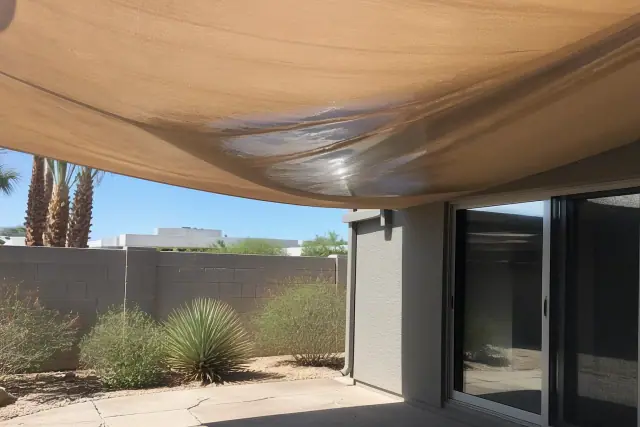
A low center pocket shows what happens when pitch or tension is inadequate. Collected stormwater stretches fabric and concentrates force at seams and anchor points.
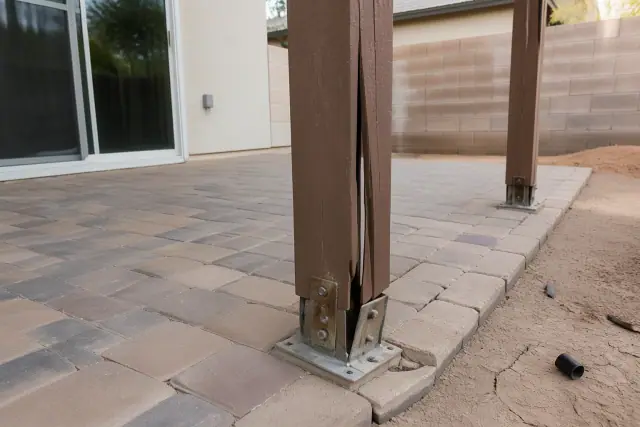
Leaning posts, enlarged wall fastener holes, and distorted turnbuckles reveal how wind load travels through a sail. These details matter before the fabric tears loose from stucco or block.
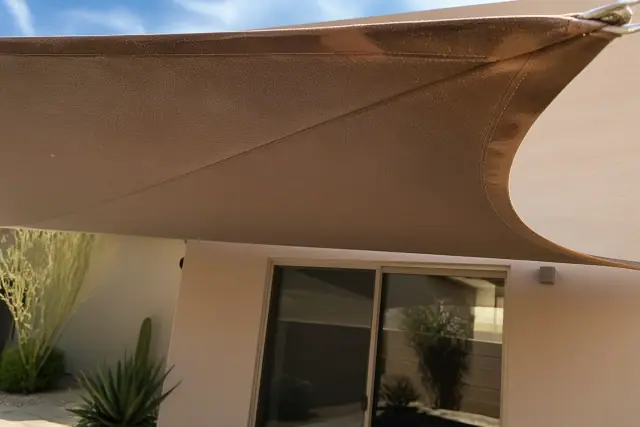
Fading, puckered webbing, and brittle fibers at D-ring corners are visible signs of UV and heat fatigue. Dark fabric commonly shows this decline sooner than lighter, more reflective colors.
A sail fits renters, tighter budgets, temporary shade needs, and patios, pools, or play areas that need quick UV relief without a hard roof.
Expect pass-through rain, a fixed shade pattern, fabric fading, sensitivity to strong winds, and more cleaning and tension checks than a permanent hard-roof structure.
Check stitching, D-rings, shackles, tension, seams, and anchors before and after monsoon season. Start watching for replacement-level wear around year five, or sooner under all-day summer sun.
A patio cover, pergola, ramada, louvered roof, cantilever structure, or metal awning may fit better when the priority is year-round coverage, waterproofing, durability, or lower maintenance.
| Priority | Shade Sail Trade-Off | Decision Cue |
|---|---|---|
| Upfront budget | Professional Phoenix-area sails commonly run from a few hundred to a couple thousand dollars. | Compare size, fabric grade, and post engineering, then account for later fabric replacement. |
| Rain protection | Knitted shade cloth lets rain through, while PVC-coated fabric costs more and must be pitched and tensioned correctly. | Choose a hard-roof option when fully shed rain is essential. |
| Monsoon exposure | Gusts can exceed 50-60 mph and load posts, footings, seams, and anchors. | Use engineered supports or a design that can be removed before severe weather. |
| Low upkeep | Fabric needs cleaning two to four times a year plus twice-yearly hardware and stitching checks. | Compare a patio cover or louvered roof when minimal seasonal attention matters. |
| Consistent coverage | A fixed sail cannot follow changing daily or seasonal sun angles. | Map the full shade pattern or consider an adjustable structure. |
A shade sail is a tensioned span of knitted or woven fabric held between three or more posts or wall anchors. Its light, breathable construction delivers fast shade, but that same construction allows rain through and transfers wind forces into every footing and connection. Because the sail is fixed, its shadow moves off the target area as daily and seasonal sun angles change. The result is useful UV relief with less weather protection, adjustability, and longevity than many permanent structures.
Even UV-stabilized HDPE fabric in the 340-440 GSM range gradually loses tensile strength under Arizona's roughly 3,800+ hours of annual sunshine, especially when sustained heat climbs above 110°F. Dark fabric absorbs more heat, while dust and grit abrade fibers at seams and D-ring corners. Temperature swings between 115°F summer days and 40°F winter nights can loosen turnbuckles and reduce tension. Most failures follow three connected weaknesses: undersized posts or footings, hardware that is not re-tensioned seasonally, and fabric that is not rated for desert UV. Posts, wall attachments, runoff pitch, and hardware must be evaluated together against regional wind loads and applicable International Building Code and ASCE 7 requirements.
A properly engineered sail can stay up all year, but removing it for the roughly three-month monsoon window can reduce stress on fabric and anchors. Lighter colors generally stay cooler and resist visible fading longer, while darker colors reduce more visible glare but absorb more heat. Standard cloth is not waterproof; PVC-coated alternatives can shed water only with adequate pitch and tension. Commercial hardware may outlast the fabric and be reusable when the panel is replaced, and damp folds near pools or irrigation should be cleaned and dried to limit mildew.
Share the area's sun path, wind exposure, desired rain protection, maintenance expectations, and budget. A local shade-structure team can compare fabric grade, wind rating, anchoring conditions, and alternatives before recommending an engineered sail or a more permanent structure.